
There is a peculiar, bitter strain of commentary that occasionally surfaces in Nigerian media; one that reflexively sneers at homegrown ambition while bowing at the altar of foreign validation.
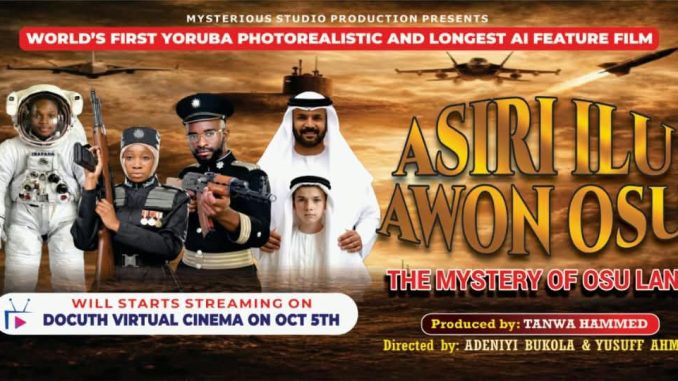
Nowhere is this more glaring than in the recent hatchet jobs published by The Generated and Ileabinibi.com regarding Asiri Ilu Awon Osu (Mystery of Osu Land), the world’s first Yoruba photorealistic AI feature film
Faced with a genuinely daring milestone in indigenous filmmaking, both platforms opted for lazy cynicism and petty gatekeeping over honest critical engagement.
Operating out of Ibadan, Oyo State, Mysterious Tech Studio, led by CEO Olarinde Abdul Rofeeq, writer Yusuff Kafilat, co-creator Tanwa Hameed (popularly known as Asake Omogbajumo), and directors Adeniyi Bukola and Yusuff Ahmad—did what heavily funded studios in Lagos and beyond have scarcely dared to try.
They delivered a three-hour, photorealistic AI-assisted Yoruba feature film. Rather than recognising the sheer audacity, technical grit, and cultural pride required to pull off such a feat, The Generated and Ileabinibi.com bent over backwards to diminish it, weaponising selective metrics and bureaucratic nitpicking to tear down pioneers.
Take their obsession with policing the film’s “first” billing. Comparing an indigenous Yoruba sci-fi drama to Western AI releases or hiding behind rigid Guinness World Record technicalities completely misses the cultural significance of the moment. Asiri Ilu Awon Osu is a watershed achievement for Yoruba cinema and African tech-driven storytelling.
Even worse is the sheer bad-faith journalism involved in trying to debunk the studio’s “80% AI” production claim by counting frames in a two-minute promotional trailer, watched on mute, no less. Any serious film critic knows that trailers are cut for rhythm, intrigue, and marketing punch; they are not forensic audits of a three-hour rendering pipeline.
Treating a teaser clip as definitive proof of deception is not investigative reporting; it is intellectual dishonesty dressed up as scrutiny.
Equally laughable is how both outlets attempted to downplay real audience demand by pointing to YouTube subscriber counts, X (formerly Twitter) impressions, and Google Play download figures. Anyone who actually understands the Nigerian entertainment ecosystem knows that Yoruba cinema does not live or die by X algorithms. It thrives on grassroots mobilisation through tight-knit WhatsApp broadcast lists, Facebook communities, Instagram word-of-mouth, and direct diaspora networks.
You cannot fake the kind of genuine commercial appetite that sends waves of paying viewers at home and abroad rushing to stream a film on launch night, to the point where Docuth’s hosting servers buckled under the traffic.
When those third-party bandwidth bottlenecks temporarily locked eager fans out of registering or streaming on premiere night, Mysterious Tech Studio did not duck for cover or point fingers.
They stepped forward with rare grace, issuing a transparent, accountable public apology, and working through the night to sort out access for intended viewers.
For The Generated and Ileabinibi.com to twist a moment of honest customer care into cheap mockery of the filmmakers’ numbers exposes an agenda rooted in malice rather than objectivism.
Real innovation in Nigeria rarely arrives with Silicon Valley budgets or flawless infrastructure; it is forged through stubborn resilience, trial and error, and bold creative risk-taking.
Mysterious Tech Studio and the entire Asiri Ilu Awon Osu team deserve full credit for proving that indigenous African languages belong at the cutting edge of global AI cinema.
No doubt, healthy critique sharpens an industry, while bitter attempts to sabotage trailblazers only expose the critics’ small-mindedness.