
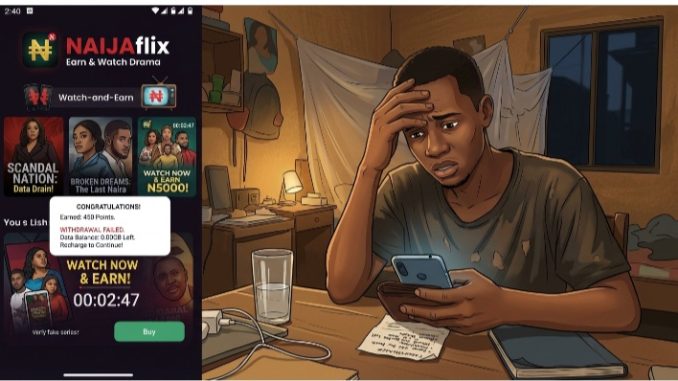
Adebowale, a young Nigerian who lived for the constant buzz of his Android phone, found himself staring at a dreaded “Sign in to network” notification.
He was completely broke, and the last of his money had just vanished into the data-guzzling vortex of social media videos. Desperate for a fix, he flashed his uncle twice. When the phone rang back, Adebowale polished his manners. “Uncle Demola, good afternoon, sir. How are you and the family?” After exchanging the mandatory cultural pleasantries and receiving praise for being a “thoughtful’ nephew, Adebowale dropped the real hook: “I wouldn’t mind if you can subscribe for data for me, sir. I would appreciate it.” His uncle agreed, and minutes later, the sweet alert of a successful data top-up arrived.
Adebowale immediately dived back into his feed. Twenty minutes later, the ultimate Nigerian horror story struck: a stinging SMS arrived announcing his data was 100% exhausted.
This frustrating cycle of burning precious data on endless video loops is a reality millions of Nigerians face daily—and a predatory new industry has found a way to weaponise it, including the communications companies.
A surging wave of mobile applications claiming to pay everyday users thousands of Naira for watching short, vertical “mini-dramas” is currently running a highly sophisticated advertising scam across Nigeria, an investigation by TheDispatchng has revealed.
Striking at a time when economic hardship makes the promise of “easy internet money” irresistible, these apps trap data-starved youth in a loop of endless ads, consuming their expensive data bundles while delivering absolutely nothing in return.
The investigation into platforms like Top Drama, along with dozens of identical clones dominating digital app stores, has unmasked an organised network of predatory developers reaping massive profits from unsuspecting users.
TheDispatchng found that these apps exploit the current economic hardships in Nigeria, promising a lifeline of easy cash through “watch-and-earn” rewards, only to trap users in an endless loop of forced ad-viewing without ever paying out a single Kobo.
The Anatomy of the Deception
According to TheDispatchng’s findings, the scam operates through a calculated, psychological sequence designed to maximise the user’s time and mobile data before cutting them off.
• The Hook: Users are lured via social media ads featuring emotional vertical soap operas. Upon downloading, the app immediately grants a “welcome bonus” of ₦2,000 to ₦5,000, creating an illusion of rapid progress.
• The Grind: To reach the withdrawal threshold—usually fixed at ₦10,000 or ₦20,000—the app forces the user to watch dozens of unskippable 30-second video advertisements for casinos, forex trading, and shady betting apps.
• The Bait-and-Switch: Once the target threshold is finally met, the app undergoes a sudden, mechanical shift. The “Withdraw” button ceases to function, replaced by a newly introduced set of impossible constraints.
• The Moving Goalposts: Journalists at TheDispatchng tracked users who were hit with sudden mandates to “Watch 60 more ads,” “Invite 10 friends via a referral link,” or “Wait in an artificial 9-day processing queue.” When these tasks are finished, the app simply resets the requirements or locks the user account entirely.
Who Profits from the Scam?
The financial mechanics of these apps are entirely one-sided.
Cyber-security analysts who spoke to TheDispatchng stated that the developers utilise Google AdMob, Unity Ads, and other programmatic advertising networks to get paid in U.S. dollars for every single impression generated by the user.
While the developer earns hard currency for forcing ads onto Nigerian screens, the victim absorbs 100% of the financial liability.
TheDispatchng documented instances where users routinely burned through expensive data bundles—often spending ₦3,000 to ₦5,000 on internet subscriptions in pursuit of a payout that does not exist.
Investigation equally revealed that, if an application requests an upfront “activation fee,” “withdrawal tax,” or “verification payment” to release your accumulated funds, it crosses from ad-fraud into direct financial theft.
TheDispatchng’s investigation further showed that legitimate reward platforms never demand payment to withdraw earnings.
Protecting Your Digital Footprint
The Nigeria Data Protection Commission (NDPC) and digital safety advocates urge extreme caution when downloading entertainment apps that prioritize wallet balances over actual content.
To stay safe online, experts recommend verifying apps through user reviews on the Google Play Store, avoiding platforms that demand access to your contacts or SMS permissions, and refusing to pay any upfront fees to unlock rewards.