
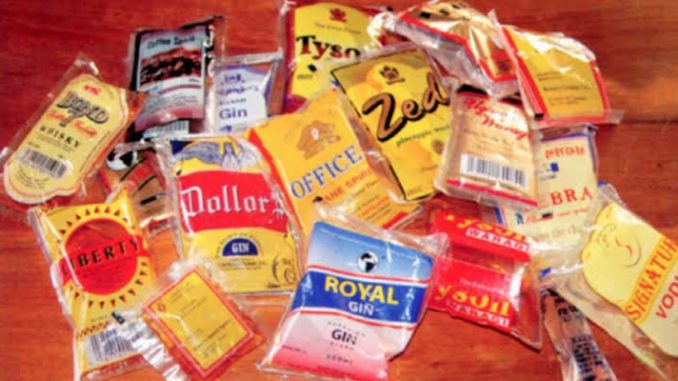
The President Bola Tinubu-led Nigerian government has ordered the National Agency for Food and Drug Administration and Control (NAFDAC) to immediately halt its crackdown on the production and distribution of sachet alcohol and 200ml PET bottle alcoholic drinks across the country.
The directive also compels the regulatory agency to end its nationwide sealing factories, depots, and warehouses in connection with the proposed restriction.
The directive was contained in a statement issued on Wednesday in Abuja by the Special Adviser on Public Affairs to the Secretary to the Government of the Federation (SGF), Terrence Kuanum.
Kuanum stated that the decision followed high-level consultations involving the Office of the SGF and the Office of the National Security Adviser (NSA), which both expressed reservations about the timing and implementation strategy of the ban.
The two offices, according to Kuanum, cautioned that enforcing the restriction without the full rollout of a comprehensive National Alcohol Policy could trigger unintended economic and security consequences.
“Consequently, all enforcement activities and related decisions concerning the sachet alcohol restriction are hereby suspended pending the conclusion of consultations and the proper implementation of the National Alcohol Policy, alongside further government directives,” the statement read.
Although the National Alcohol Policy has already been endorsed by the Federal Ministry of Health in compliance with President Bola Tinubu’s directive, the SGF and NSA offices maintained that enforcement actions must not proceed until the framework is fully operational and harmonised.
The Nigerian government specifically directed NAFDAC to discontinue measures such as factory closures, warehouse sealings, and public communications, suggesting an outright ban.
The statement noted that ongoing enforcement actions, described as amounting to a “de facto ban,” had begun to disrupt supply chains and negatively impact businesses, particularly within informal distribution networks that rely heavily on low-cost alcohol products.
It warned that job losses and economic strain could heighten social tensions if not carefully managed.
Kuanum explained that the latest directive reinforces an earlier instruction issued by the SGF’s office in December 2025, which had already called for a pause on the proposed ban pending broader stakeholder engagement and a final policy decision.
He further revealed that the SGF’s office had received correspondence from the House of Representatives Committee on Food and Drugs Administration and Control, dated November 13, 2025, drawing attention to resolutions of the National Assembly on the issue.
The letter, referenced NASS/10/HR/CT.53/77 and signed by the committee’s Deputy Chairman, Hon. Uchenna Okonkwo, urged caution regarding the enforcement approach and called for alignment with legislative resolutions.
The Nigerian government stated that it is currently reviewing the matter holistically, taking into account legislative inputs, public health objectives, economic realities, and broader national interest considerations.
It added that the involvement of the National Security Adviser underscores the wider implications of the issue beyond regulatory compliance, stressing that any action capable of triggering unemployment or instability must be carefully evaluated.
The government assured industry players and members of the public that a final position would be announced after comprehensive consultations and inter-agency coordination, with due regard for public health, economic stability, and national security.