
. The Role Played By Red Cross
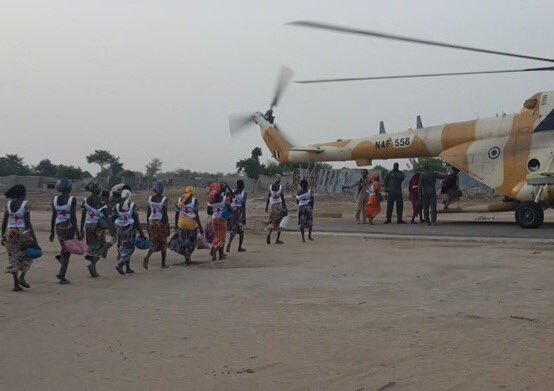
The government of Nigeria has revealed that the eighty-two Chibok girls were released exchange for Boko Haram suspects already held by the authorities.
Garba Shehu, senior special assistant on media and publicity to the president, in a statement released on Saturday, said that negotiations with the Boko Haram sect resulted in the freedom of the girls.
He noted that the negotiations were carried out in collaboration with security agencies, the military, the Switzerland government, Red Cross, local and international non-governmental organisations.
Shehu said that President Muhammadu Buhari received daily briefings throughout the negotiation process.
According to the statement, the president is expected to meet with the girls on Sunday.
“President Muhammadu Buhari is pleased to announce that negotiations to release more of the #ChibokGirls have yielded results. Today, 82 more #ChibokGirls were released,” it said.
“After lengthy negotiations, our security agencies have taken back these girls, in exchange for some Boko Haram suspects held by the authorities.
“The released #ChibokGirls are due to arrive in Abuja tomorrow Sunday May 7, and will be received by the President.
“President Muhammadu Buhari expresses his deep gratitude to all who played a part in ensuring the success of this operation, as follows: Security agencies, the military, the Government of Switzerland, the International Committee of the Red Cross, and local and international NGOs.
“The President has repeatedly expressed his total commitment towards ensuring the safe return of the #ChibokGirls, and all other Boko Haram captives.
“The President has received detailed briefings from the Director-General of the Department of State Services (DSS) at every stage of the negotiations/operation.”
Out of the 276 girls abducted from Government Secondary School, Chibok, Borno state, in April 2014, 163 have regained their freedom.
The Role Played By Red Cross
International Committee of the Red Cross (@ICRC) in Africa has explained its role in the freedom of 82 Chibok schoolgirls abducted by Boko Haram militants since 14 April, 2014.
The agency said on its Twitter page that it only acted as an intermediary between Boko Haram and the Nigerian government. And then also its vehicles were used to transport the freed girls to Nigerian officials at Banki, in Borno state.
Patrick Youssef who tweeted the agency’s position said: “With the agreement of all the parties involved, we @ICRC acted as a neutral intermediary to facilitate their transport back
“Many families have lost contact because of the conflict and the #LakeChadCrisis. We’re so relieved in this case that families can be reunited”.
ICRC had played a similar role last year October, when Nigeria got the first batch of 21 Chibok girls released.