
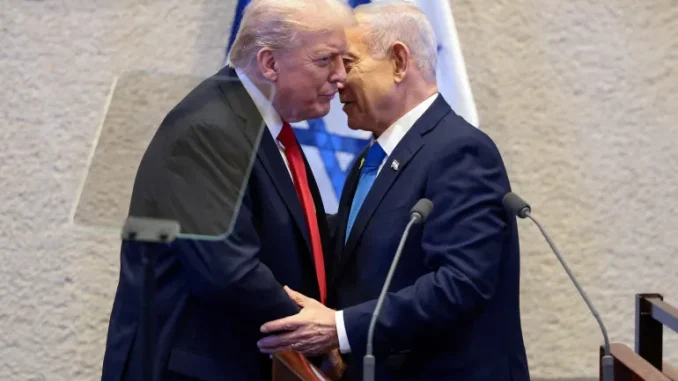
United States President Donald Trump has concluded a White House meeting with Israeli Prime Minister Benjamin Netanyahu, saying that “nothing definitive” had been reached during their exchange.
But he added that US talks with Iran would continue, as he pushes for Tehran to concede to a list of demands.
It was a very good meeting, the tremendous relationship between our two Countries continues,” Trump said of Israel.
“There was nothing definitive reached other than I insisted that negotiations with Iran continue to see whether or not a Deal can be consummated.”
Wednesday’s meeting was Trump’s sixth time hosting Netanyahu in the US since the start of his second term. They have met a total of seven times — including once in Israel — since January 2025.
The latest visit came just days after US and Iranian officials held indirect talks in Oman aimed at diverting a military confrontation that could spill into the wider Middle East region.
While Arab leaders have largely advocated for deescalation, Netanyahu has repeatedly called for further military action against Iran.
Netanyahu’s latest visit took place behind closed doors. After their visit was over, Trump posted on his Truth Social account that it had been a “tremendous meeting”. He also wrote that he had hope a deal could be struck with Iran.
“If it can, I let the Prime Minister know that will be a preference,” Trump said. “If it cannot, we will just have to see what the outcome will be.”
Trump previously sided with Israel in a 12-day war against Iran last June. The conflict culminated with US strikes on three Iranian nuclear sites, in a military operation dubbed “Midnight Hammer”.
In Wednesday’s post, the US president appeared to threaten further military action against Iran, pointing out that June’s attack came after talks on Iran’s nuclear programme failed to make progress.
Last time Iran decided that they were better off not making a Deal, and they were hit with Midnight Hammer,” Trump wrote. “That did not work well for them. Hopefully this time they will be more reasonable and responsible.”
Netanyahu’s office, meanwhile, offered few details, saying only that the pair discussed Israel’s “security needs” and agreed to “continued coordination and close ties”.
Among the topics discussed were “negotiations with Iran, Gaza and regional developments”, the statement said.
Iran says ballistic missile ‘non-negotiable’
Trump has signalled optimism in the wake of Friday’s talks in Oman, which included US envoy Steve Witkoff, the president’s son-in-law Jared Kushner and Iranian Foreign Minister Abbas Araghchi.
The gathering came after the US surged military assets to the region, raising the prospect of a military entanglement.
Since January, Trump has pledged to strike Iran if the country’s security agents kill protesters involved in recent antigovernment demonstrations.
Iran’s Supreme Leader Ayatollah Ali Khamenei, in turn, warned of a “regional war” in the event of a US attack.
Regional powers across the Middle East have pushed for a diplomatic solution to avoid a military clash.
The Trump administration, meanwhile, has not been clear on the scope of its talks with Iran.
However, officials have told US media outlets that the recent negotiations hinge on three main demands: ending Iran’s nuclear enrichment programme, curtailing its ballistic programme and cutting its support for regional proxies, a goal long held by Netanyahu as well.
The US had previously entered into an agreement to scale back Iran’s nuclear programme in 2015.
That multilateral deal, known as the Joint Comprehensive Plan of Action (JCPOA), offered Iran sanctions relief. The United Kingdom, France, China, Russia, Germany and the European Union were all participants.
But in 2018, during his first term, Trump withdrew from the JCPOA. Ever since, he has unsuccessfully pursued a new agreement while re-imposing “maximum pressure” sanctions on Iran.
Iranian officials have signalled they are open to reaching a new deal on their nuclear programme, which they have maintained is only for civilian purposes. But they maintain their ballistic missile capabilities should remain off limits.
“The Islamic Republic’s missile capabilities are non-negotiable,” Ali Shamkhani, an adviser to Khamenei, was quoted by state media as saying on Wednesday.