
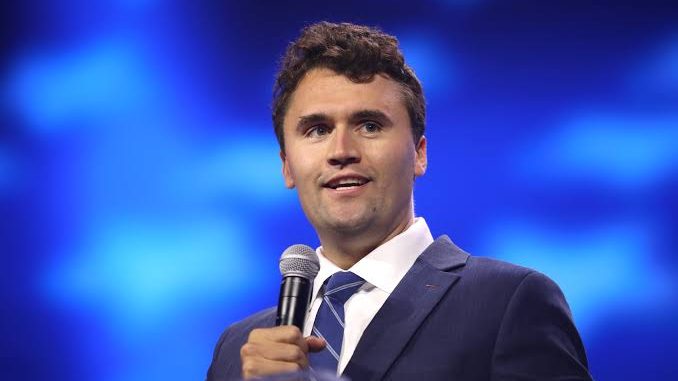
The assassination of Charlie Kirk is no doubt a grave tragedy that must be unequivocally condemned.
Political violence, regardless of its target or motivation, is an abhorrent affront to the rule of law and civility. No human life should be extinguished as a consequence of ideological disputes or partisan animosities.
Our society must begin by firmly rejecting violence as a form of political expression, standing united against all acts that undermine peace and public safety.
Yet, while condemning this senseless act, it is imperative to resist the seductive impulse to elevate Charlie Kirk into a heroic or sanctified political figure. To do so would be a disservice to truth and historical accuracy. Kirk’s public career was characterized by a relentless propagation of racial animus and exclusionary nationalism that cannot be ignored or glossed over.
His rhetoric and actions consistently reflected a white supremacist mindset, coupled with a virulent Islamophobia that further inflamed divisions in an already fractured society.
Kirk’s Islamophobia was not a mere incidental prejudice – it was foundational to his worldview. He positioned himself vocally against Muslim communities, fostering suspicion, fear, and outright hatred. Such discourse feeds into a dangerous climate that emboldens discrimination and legitimises bigotry under the banner of political conservatism.
More disturbingly, Kirk unabashedly supported the genocidal campaign in Gaza, openly endorsing policies that led to mass suffering and death. His stance on this tragic conflict illustrates a stark indifference to human rights and international law, revealing a moral latitude that is deeply troubling. Support for the systematic oppression and decimation of a people cannot be excused as political posturing; it constitutes complicity in atrocity.
The complexity of this moment demands a clear-eyed reckoning. It is possible- and necessary – to reject the violence that ended Kirk’s life while simultaneously refusing to sanitize or idolise his legacy. The invocation of “multiple truths” in this context must not become a smokescreen that obscures the reality of the harm he propagated.
His supporters’ posthumous framing of Kirk as a symbol for relentless conflict underscores a cynical exploitation of grief and tragedy to fuel further discord.
Let us be clear: the figure assassinated was a white man, and acknowledging this fact should prompt frank discussions about how race, media, and political power shape narratives around violence. Had the victim been Black or an immigrant, the story and its implications would likely have played out differently, exposing uncomfortable truths about whose lives receive urgent attention and whose are merely politicised or ignored.
In confronting Charlie Kirk’s death, society faces a dual imperative: to unequivocally condemn the evil of political assassination, and to confront honestly the legacy of a man who championed division, hatred, and violence.
True progress demands neither blind veneration nor dismissive erasure, but the courage to hold these uncomfortable truths in tension – and to forge a future where neither hate nor violence have a place in our political discourse.